

Making the right business decisions in Dubai requires more than experience or intuition. Whether you’re launching a startup, expanding an existing company, or entering the UAE market as a foreign investor, every decision can influence your long-term success. A well-structured consultation process helps businesses evaluate opportunities, understand potential risks, and build strategies based on reliable data rather than assumptions.
The Business Consultation Process in Dubai is designed to provide a clear framework for analyzing business objectives, studying market conditions, developing effective strategies, and preparing for sustainable growth. Instead of focusing on a single aspect of a business, this process considers financial, operational, legal, and competitive factors to support informed decision-making.
In this guide, you’ll learn how each stage of the consultation process contributes to building a stronger business foundation, why every step matters, and how a systematic approach can help businesses improve efficiency, reduce risks, and achieve long-term success in Dubai’s competitive business environment.

What Is the Business Consultation Process?
A business consultation process is a structured approach that helps entrepreneurs, business owners, and organizations evaluate their current situation, identify opportunities, solve challenges, and develop practical strategies for achieving their goals. Rather than offering generic advice, the process is based on understanding a company’s unique objectives, market conditions, financial position, and operational requirements.
In Dubai’s fast-moving and highly competitive business environment, a structured consultation process enables businesses to make informed decisions before investing time, money, or resources. It provides a clear framework for assessing potential risks, analyzing market opportunities, and creating realistic action plans that support sustainable growth.
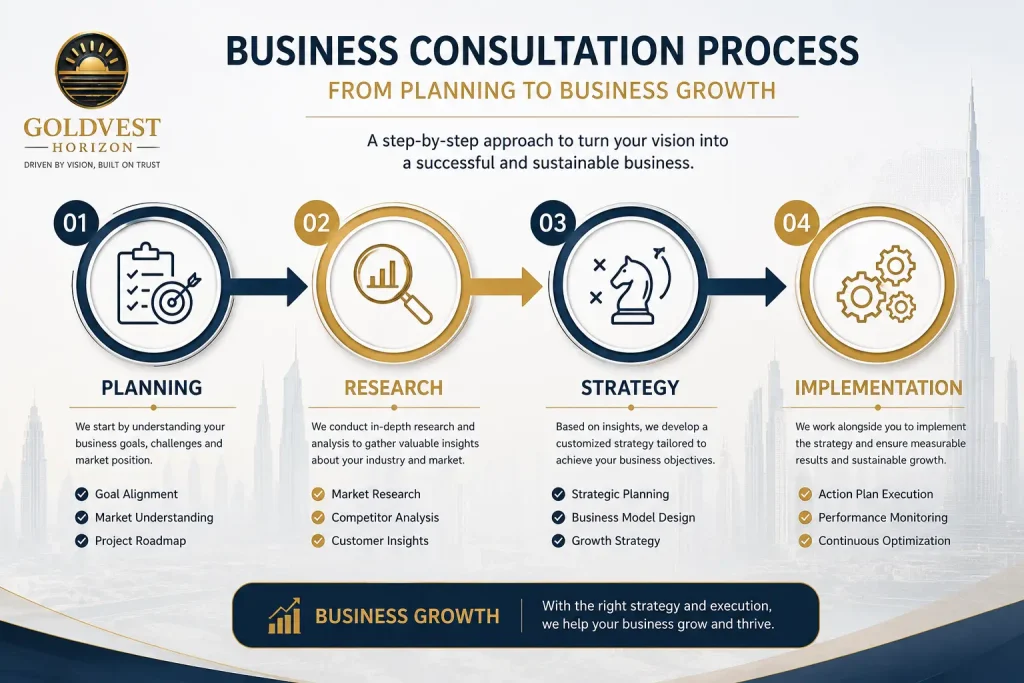
Although every business has different needs, most consultation processes follow a similar path. They typically begin with understanding business objectives, followed by market and competitor analysis, strategic planning, legal and operational considerations, implementation planning, and ongoing performance evaluation. Each stage builds on the previous one to ensure that important decisions are made using accurate information instead of assumptions.
It’s also important to understand that a business consultation process is broader than simply registering a company or obtaining a trade license. While legal procedures are important milestones, effective consultation focuses on the overall business strategy, helping companies create a solid foundation before moving forward with expansion or investment decisions.
Why Is a Structured Business Consultation Process Important?
A structured business consultation process provides businesses with a clear direction before making critical decisions. Instead of relying on assumptions or reacting to challenges as they arise, companies can evaluate their goals, identify potential risks, and develop practical strategies based on accurate information. This systematic approach reduces uncertainty and increases the likelihood of achieving long-term business success.
For businesses operating in Dubai, where regulations, market trends, and customer expectations continue to evolve, following a structured consultation process is even more valuable. It enables organizations to adapt to changing conditions, allocate resources efficiently, and make confident decisions that support sustainable growth.
A well-planned consultation process also improves communication among stakeholders, aligns business objectives with market opportunities, and ensures that every major decision is supported by research and strategic planning rather than guesswork.
Key Benefits of a Structured Business Consultation Process
- Provides a clear roadmap for business planning and decision-making.
- Identifies potential risks before significant investments are made.
- Supports data-driven strategies through market and competitor analysis.
- Improves resource allocation and operational efficiency.
- Helps businesses adapt to changing market conditions.
- Creates measurable goals and performance indicators for continuous improvement.
- Builds a stronger foundation for long-term business growth and expansion.
Regardless of the size or industry of a business, following a structured consultation process helps transform ideas into actionable plans. By approaching each stage methodically, businesses can reduce uncertainty, improve strategic decision-making, and position themselves for sustainable success in Dubai’s competitive business landscape.
Key Stages of the Business Consultation Process
A successful business consultation follows a structured framework that guides businesses from initial planning to long-term growth. While the specific approach may vary depending on the industry, company size, and business objectives, the core stages remain consistent. Each stage builds upon the previous one, ensuring that decisions are made strategically rather than reactively.
Following these stages allows businesses to identify opportunities, minimize potential risks, improve operational efficiency, and create a clear roadmap for sustainable success. By understanding the complete consultation journey, business owners can better prepare for each phase and make more informed decisions throughout the process.
The Six Core Stages of the Business Consultation Process
| Stage | Primary Objective |
|---|---|
| Understanding Business Goals | Define business objectives, priorities, and long-term vision. |
| Market Research & Competitor Analysis | Evaluate market conditions, customer needs, and competitive opportunities. |
| Business Strategy Development | Create a practical roadmap for growth and business success. |
| Legal Structure & Regulatory Planning | Prepare for compliance, licensing, and the appropriate business structure. |
| Implementation & Execution | Turn strategic plans into measurable business actions. |
| Monitoring & Continuous Improvement | Track performance, measure results, and optimize business strategies. |
Although these stages are presented in sequence, business consultation is rarely a one-time activity. As markets evolve, customer expectations change, and business priorities shift, organizations often revisit earlier stages to refine their strategies and identify new opportunities. This continuous cycle of planning, execution, and improvement helps businesses remain competitive in Dubai’s dynamic business environment.
In the following sections, we’ll explore each stage in detail and explain how every step contributes to building a stronger, more resilient, and growth-oriented business.
Step 1: Understanding Business Goals
The first and most important step in any business consultation process is understanding the business goals. Without clearly defined objectives, it becomes difficult to create an effective strategy, allocate resources efficiently, or measure success. Every recommendation made during the consultation should be aligned with the company’s long-term vision and short-term priorities.
During this stage, consultants work closely with business owners and key stakeholders to gain a complete understanding of the organization. This includes identifying the purpose of the business, its current position in the market, available resources, and future growth ambitions. A clear understanding of these factors helps establish realistic expectations and provides the foundation for every decision that follows.

Key Areas to Evaluate
- Short-term and long-term business objectives.
- Target customers and ideal market segments.
- Available financial and operational resources.
- Business strengths, weaknesses, opportunities, and potential risks.
- Current challenges affecting business performance.
- Growth expectations and expansion plans.
- Timeline for achieving strategic milestones.
Clearly defining business goals also helps prioritize actions. For example, a startup entering the Dubai market may focus on validating its business model and attracting its first customers, while an established company may prioritize market expansion, operational efficiency, or increasing profitability. Since every business has unique objectives, the consultation process should always be tailored to its specific needs rather than following a one-size-fits-all approach.
Questions to Ask During This Stage
- What are the primary goals of the business over the next one to five years?
- Who is the ideal target audience?
- What challenges are preventing business growth?
- Which products or services generate the highest value?
- What resources are available to achieve these goals?
- How will success be measured?
By establishing clear business goals at the beginning of the consultation process, businesses can make more informed decisions throughout the following stages. This strategic foundation ensures that market research, business planning, legal considerations, and implementation efforts all support the same long-term objectives.
Step 2: Market Research and Competitor Analysis
Once business goals have been clearly defined, the next step is to understand the market in which the business will operate. Market research and competitor analysis provide valuable insights into customer behavior, industry trends, demand, pricing strategies, and competitive positioning. These insights help businesses make informed decisions before investing significant time and resources.
Dubai is home to one of the world’s most dynamic business environments, attracting companies from a wide range of industries. Because of this competitive landscape, understanding market conditions before launching or expanding a business is essential. A thorough market analysis enables businesses to identify opportunities, anticipate challenges, and develop strategies that align with customer needs and market expectations.
What Should Market Research Include?
- Industry trends and market size.
- Customer demographics and buying behavior.
- Target audience needs and expectations.
- Current market demand for products or services.
- Pricing strategies within the industry.
- Emerging business opportunities.
- Potential barriers to market entry.
Why Competitor Analysis Matters
Competitor analysis helps businesses understand how other companies operate within the same market. By evaluating competitors’ strengths, weaknesses, pricing models, marketing strategies, and customer experiences, businesses can identify market gaps and create a stronger competitive advantage.
- Identify direct and indirect competitors.
- Evaluate competitors’ products and services.
- Analyze pricing and positioning strategies.
- Review customer feedback and market reputation.
- Discover opportunities for differentiation.
For companies planning to expand into the UAE, conducting thorough market research before entering the market is a critical step. Understanding local regulations, customer expectations, and competitive conditions can significantly improve the chances of long-term success. Businesses seeking a structured approach to evaluating opportunities before expansion can also explore our Market Entry Support services for additional guidance.
By combining comprehensive market research with detailed competitor analysis, businesses gain a stronger foundation for developing effective strategies. The insights gathered during this stage directly support the next phase of the consultation process, where these findings are transformed into practical business strategies and actionable growth plans.
Step 3: Business Strategy Development
After defining business goals and analyzing the market, the next step is to develop a clear business strategy. This stage transforms research and insights into a practical action plan that guides business decisions, supports growth, and helps organizations achieve their objectives. Without a well-defined strategy, even promising business opportunities can be difficult to execute successfully.
A business strategy outlines how a company will compete in the market, attract customers, generate revenue, and achieve sustainable growth. Rather than focusing only on short-term objectives, it establishes a long-term direction while remaining flexible enough to adapt to changing market conditions.
Key Components of a Business Strategy
- Defining a clear value proposition.
- Identifying target customer segments.
- Setting realistic short-term and long-term business goals.
- Developing pricing and revenue strategies.
- Creating marketing and customer acquisition plans.
- Planning operational processes and resource allocation.
- Establishing measurable Key Performance Indicators (KPIs).
A successful strategy should also consider potential risks and identify opportunities for future expansion. This proactive approach allows businesses to respond more effectively to market changes while maintaining focus on their long-term vision.
Aligning Strategy with Business Goals
Every strategic decision should support the objectives identified during the first stage of the consultation process. Whether the goal is entering a new market, increasing profitability, improving operational efficiency, or expanding into new industries, the strategy must provide a clear roadmap for achieving those outcomes.
Businesses should avoid adopting strategies based solely on industry trends or competitors’ actions. Instead, strategic planning should be built around the organization’s unique strengths, available resources, customer expectations, and competitive advantages.
Creating an Actionable Growth Plan
Once the overall strategy has been defined, it should be translated into a practical implementation plan. This includes assigning responsibilities, setting timelines, prioritizing initiatives, and monitoring progress through measurable performance indicators. Breaking large objectives into manageable milestones helps businesses stay focused and adjust their approach when necessary.
Organizations seeking long-term success often combine strategic planning with continuous business performance reviews. A structured growth strategy not only improves day-to-day decision-making but also prepares businesses to respond to new opportunities as markets evolve. Businesses looking to strengthen their long-term planning and expansion strategy can also benefit from our Business Growth Advisory services.
With a comprehensive business strategy in place, organizations are better prepared for the next stage of the consultation process—evaluating legal structures, regulatory requirements, and compliance considerations before moving toward implementation.
Step 4: Legal Structure and Regulatory Planning
Once a business strategy has been established, the next step is ensuring that the business is built on the right legal and regulatory foundation. Choosing an appropriate legal structure and understanding the applicable regulations are essential for protecting the business, maintaining compliance, and supporting long-term growth. Decisions made at this stage can influence taxation, ownership, operational flexibility, and future expansion opportunities.
Dubai offers a variety of business structures designed to meet different commercial objectives. The most suitable option depends on factors such as the nature of the business activity, ownership requirements, target market, and long-term business goals. Selecting the wrong structure at the beginning can lead to unnecessary costs, operational limitations, or regulatory challenges in the future.
Key Factors to Consider
- The nature of the business activity.
- Ownership and shareholder requirements.
- Target market and business location.
- Regulatory obligations and compliance requirements.
- Tax considerations and financial planning.
- Future expansion and scalability.
- Licensing and operational requirements.
Regulatory planning is not limited to selecting a business structure. It also involves understanding the legal obligations that apply to a business throughout its lifecycle. This includes maintaining compliance with local regulations, keeping accurate business records, meeting reporting requirements, and adapting to regulatory updates when necessary.
Why Early Legal Planning Matters
Addressing legal and regulatory considerations before launching a business helps reduce potential risks and prevents costly changes later. Early planning allows businesses to align their operational strategy with legal requirements while ensuring that future growth plans can be implemented without unnecessary obstacles.
For businesses planning to establish operations in Dubai, understanding the available legal structures is an important part of the consultation process. You can learn more about selecting the right business structure through our Company Registration service, which explains the available options for setting up a company in the UAE.
Businesses should also ensure they obtain the appropriate license for their intended activities. Different industries and business models may require different licensing arrangements depending on regulatory requirements. Our Trade License Services page provides additional information about licensing options and related compliance requirements.
By integrating legal planning into the overall business consultation process, companies can build a stronger operational foundation, reduce regulatory risks, and prepare for successful implementation. Once these legal considerations have been addressed, the focus can shift toward executing the business strategy and turning plans into measurable results.
Step 5: Implementation and Execution
After completing the planning, market analysis, strategy development, and legal preparations, the next step is implementation. This is where ideas, strategies, and action plans are transformed into real business activities. Successful execution requires careful coordination, efficient resource management, and continuous monitoring to ensure that every objective is achieved according to the planned timeline.
Many businesses invest significant time in creating strategies but struggle during implementation. A well-designed strategy only delivers results when it is supported by clear responsibilities, realistic deadlines, effective communication, and measurable performance indicators. Turning a business plan into measurable outcomes requires consistency, accountability, and the flexibility to respond to unexpected challenges.
Essential Elements of Successful Implementation
- Creating a detailed action plan with clear priorities.
- Assigning responsibilities to the appropriate team members.
- Establishing realistic timelines and project milestones.
- Allocating financial, operational, and human resources effectively.
- Monitoring progress through measurable Key Performance Indicators (KPIs).
- Maintaining regular communication among stakeholders.
- Reviewing progress and making adjustments when necessary.
Implementation should not be viewed as a one-time activity. Instead, it is an ongoing process that requires continuous evaluation and improvement. As business conditions evolve, organizations should remain flexible enough to refine their strategies, adjust priorities, and respond to new market opportunities or operational challenges.
Common Challenges During Implementation
- Unclear responsibilities and poor communication.
- Insufficient budget or limited resources.
- Resistance to organizational change.
- Unexpected market or regulatory changes.
- Failure to monitor performance consistently.
- Setting unrealistic expectations or deadlines.
Businesses that regularly measure performance against predefined objectives are more likely to identify potential issues before they become significant problems. Monitoring progress allows decision-makers to optimize operations, improve efficiency, and ensure that strategic initiatives remain aligned with business goals.
Successful implementation creates the foundation for long-term business performance. However, execution alone is not enough. To achieve sustainable growth, businesses must continuously evaluate results, measure performance, and refine their strategies over time. This ongoing process is the focus of the final stage of the business consultation process.
Step 6: Monitoring and Continuous Improvement
The final stage of the business consultation process focuses on monitoring performance and continuously improving business operations. Implementing a strategy is only the beginning of the journey. To achieve sustainable growth, businesses must regularly evaluate their progress, measure results, and make informed adjustments based on changing market conditions and business performance.
Markets, customer expectations, technologies, and regulations continue to evolve. Businesses that consistently monitor their performance are better equipped to identify new opportunities, address potential challenges, and remain competitive. Continuous improvement enables organizations to refine their strategies instead of waiting until problems become significant.

What Should Be Monitored?
- Key Performance Indicators (KPIs) and business objectives.
- Revenue growth and profitability.
- Customer satisfaction and retention.
- Operational efficiency and productivity.
- Marketing performance and lead generation.
- Financial performance and cash flow.
- Compliance with legal and regulatory requirements.
Monitoring should be supported by accurate data and regular performance reviews. Rather than relying on assumptions, businesses should use measurable results to determine whether their current strategies are delivering the expected outcomes. If performance falls below expectations, timely adjustments can improve efficiency and reduce unnecessary risks.
Building a Culture of Continuous Improvement
Continuous improvement is not a one-time project but an ongoing business mindset. Organizations that encourage regular evaluation, innovation, and learning are often better prepared to adapt to changing market conditions. Small improvements made consistently over time can have a significant impact on long-term business success.
- Review business performance regularly.
- Collect customer and stakeholder feedback.
- Identify areas for operational improvement.
- Adapt strategies based on market trends and data.
- Invest in employee development and business innovation.
- Set new goals as the business grows.
Performance monitoring also helps businesses identify emerging opportunities. As customer needs evolve and new technologies become available, organizations can refine their products, services, and operational strategies to remain competitive in Dubai’s dynamic business environment.
A successful business consultation process does not end after implementation. It continues through ongoing evaluation, strategic adjustments, and continuous improvement. Businesses that regularly monitor their performance and respond proactively to change are better positioned to achieve long-term growth, resilience, and sustainable success.
Common Challenges During the Business Consultation Process
Even with a well-defined consultation process, businesses may encounter challenges that can affect decision-making, project timelines, and overall performance. Identifying these challenges early allows organizations to develop practical solutions, minimize risks, and maintain progress toward their business objectives. Understanding common obstacles is an important part of preparing for long-term success.
1. Unclear Business Objectives
One of the most common challenges is starting the consultation process without clearly defined goals. If business owners are uncertain about what they want to achieve, it becomes difficult to develop an effective strategy or measure success. Establishing specific, measurable, and realistic objectives provides a strong foundation for every stage of the consultation process.
2. Limited Market Knowledge
Entering a new market without sufficient research can lead to poor strategic decisions. Businesses that lack a clear understanding of customer expectations, industry trends, or competitor activities may struggle to position themselves effectively. Comprehensive market research helps reduce uncertainty and supports better decision-making.
3. Budget and Resource Constraints
Financial limitations and restricted resources often influence the speed and quality of business execution. Companies should prioritize initiatives based on available resources while maintaining flexibility to adjust plans as business conditions evolve.
4. Resistance to Change
Implementing new strategies often requires changes in business processes, technology, or organizational culture. Employees and stakeholders may be reluctant to adopt new approaches, slowing progress and reducing the effectiveness of strategic initiatives. Clear communication and leadership support play a critical role in managing organizational change.
5. Regulatory and Compliance Requirements
Businesses operating in Dubai must stay informed about legal obligations, licensing requirements, and regulatory updates. Failing to comply with applicable regulations can result in unnecessary delays, financial penalties, or operational challenges. Reviewing compliance requirements as part of the consultation process helps reduce these risks.
6. Inconsistent Performance Monitoring
Some businesses focus heavily on planning and implementation but fail to evaluate results consistently. Without regular performance reviews, it becomes difficult to identify weaknesses, measure progress, or improve future decision-making. Continuous monitoring ensures that business strategies remain aligned with organizational objectives.
How to Overcome These Challenges
- Define clear and measurable business goals before making strategic decisions.
- Conduct thorough market research before entering new markets or launching new products.
- Create realistic budgets and allocate resources efficiently.
- Encourage open communication and involve stakeholders throughout the consultation process.
- Stay informed about legal, regulatory, and compliance requirements.
- Track performance regularly using measurable Key Performance Indicators (KPIs).
- Review and adjust business strategies based on reliable data and market feedback.
While challenges are a natural part of business growth, they can be managed successfully with careful planning, informed decision-making, and a structured consultation process. Businesses that proactively address these obstacles are better positioned to achieve sustainable growth and adapt to changing market conditions.
Best Practices for a Successful Business Consultation
A successful business consultation is not determined solely by the expertise of the consultant. It also depends on how well business owners prepare, communicate their objectives, and implement recommendations. Following proven best practices helps businesses maximize the value of the consultation process while reducing unnecessary risks and delays.
Define Clear Objectives from the Beginning
Before starting the consultation process, businesses should identify what they want to achieve. Whether the goal is entering a new market, improving operational efficiency, increasing profitability, or expanding into Dubai, having clear objectives allows every recommendation to remain focused and measurable.
Make Decisions Based on Data
Successful businesses rely on accurate information rather than assumptions. Market research, customer insights, financial analysis, and competitor data should support every strategic decision. A data-driven approach reduces uncertainty and improves long-term planning.
Maintain Open Communication
Effective communication between business owners, management teams, and consultants is essential. Sharing challenges, expectations, and business priorities openly helps create practical strategies that align with organizational goals.
Be Flexible and Ready to Adapt
Business environments constantly evolve due to changing customer expectations, economic conditions, technological advancements, and regulatory updates. Companies that remain flexible and adapt their strategies when necessary are more likely to maintain a competitive advantage.
Monitor Performance Regularly
Implementation should always be followed by regular performance reviews. Measuring progress through Key Performance Indicators (KPIs) enables businesses to evaluate results, identify improvement opportunities, and make informed adjustments before small issues become significant problems.
Focus on Long-Term Value
While achieving short-term results is important, sustainable success requires a long-term perspective. Strategic planning, continuous improvement, and ongoing evaluation help businesses build resilience and remain competitive as market conditions change.
Best Practices Checklist
- Set clear and measurable business goals.
- Support decisions with reliable market and financial data.
- Communicate openly with stakeholders throughout the consultation process.
- Review progress using measurable KPIs.
- Remain flexible and adapt to changing business conditions.
- Continuously improve strategies based on performance and market feedback.
- Maintain a long-term vision while achieving short-term milestones.
Following these best practices enables businesses to gain greater value from the consultation process and build stronger foundations for sustainable growth. Organizations that combine strategic planning with continuous evaluation are better equipped to navigate challenges, seize new opportunities, and achieve long-term success in Dubai’s competitive business landscape.
Business Consultation Process for Different Business Types
Although the core principles of business consultation remain consistent, the consultation process should always be tailored to the unique needs, objectives, and challenges of each business. Factors such as company size, industry, growth stage, and expansion plans significantly influence the recommendations and strategies developed during the consultation process. A personalized approach helps businesses make better decisions and achieve more sustainable results.
Startups
Startups often require guidance in validating business ideas, identifying target markets, developing business models, and creating realistic financial plans. At this stage, consultation focuses on reducing uncertainty, minimizing risks, and building a strong foundation before launching operations.
- Business model validation.
- Market opportunity assessment.
- Financial planning and budgeting.
- Go-to-market strategy.
- Growth roadmap development.
Small and Medium-Sized Enterprises (SMEs)
SMEs typically seek consultation to improve operational efficiency, increase profitability, expand into new markets, or optimize internal processes. Strategic planning and performance improvement become the primary focus during this stage of business growth.
- Operational improvements.
- Business process optimization.
- Revenue growth strategies.
- Customer retention initiatives.
- Performance measurement.
Foreign Investors
International investors entering Dubai require a clear understanding of the local business environment, regulatory framework, and market opportunities. Business consultation helps investors evaluate risks, understand legal requirements, and develop an effective market entry strategy before establishing operations.
Businesses planning to enter the UAE market may also benefit from learning more about our Market Entry Support services, which provide additional guidance on evaluating business opportunities and market readiness.
- Market entry planning.
- Risk assessment.
- Investment strategy.
- Regulatory considerations.
- Business location evaluation.
Large Enterprises
Established organizations generally focus on long-term business transformation, operational scalability, digital innovation, and regional expansion. Consultation at this level supports strategic decision-making, organizational development, and sustainable competitive advantage.
- Business transformation.
- Expansion planning.
- Digital transformation initiatives.
- Corporate performance optimization.
- Long-term strategic planning.
Family-Owned Businesses
Family businesses often face unique challenges related to governance, succession planning, leadership transitions, and long-term sustainability. Business consultation helps create structured plans that balance business growth with family objectives while supporting future generations.
- Succession planning.
- Leadership development.
- Governance structure.
- Business continuity planning.
- Long-term sustainability.
Regardless of the business type, a successful consultation process should always be aligned with the organization’s objectives, available resources, and future vision. By adapting strategies to the specific needs of each business, organizations can improve decision-making, reduce unnecessary risks, and position themselves for sustainable growth in Dubai’s competitive business environment.
How Technology Is Transforming Business Consultation
Technology has significantly changed the way businesses approach consultation and strategic planning. Modern organizations no longer rely solely on experience and intuition to make important decisions. Instead, they use advanced digital tools, real-time data, and artificial intelligence to evaluate business performance, identify opportunities, and support informed decision-making.
For businesses operating in Dubai’s fast-paced and competitive environment, technology provides greater visibility into market trends, customer behavior, financial performance, and operational efficiency. These insights enable business owners and consultants to make faster, more accurate decisions while reducing uncertainty and improving long-term planning.
Artificial Intelligence (AI)
Artificial intelligence is becoming an essential tool in business consultation. AI-powered solutions can analyze large volumes of data, identify patterns, forecast trends, and generate valuable insights that support strategic planning. Rather than replacing human expertise, AI enhances decision-making by providing faster access to relevant information.
- Forecasting market trends.
- Analyzing customer behavior.
- Identifying business opportunities.
- Supporting strategic decision-making.
- Reducing manual analysis time.
Business Intelligence and Data Analytics
Business Intelligence (BI) platforms and data analytics tools allow organizations to transform raw data into meaningful business insights. By monitoring performance indicators, customer trends, and operational metrics, businesses can evaluate their progress and make evidence-based decisions.
- Real-time business reporting.
- Performance measurement using KPIs.
- Financial and operational analysis.
- Sales and revenue forecasting.
- Business performance optimization.
Customer Relationship Management (CRM)
Customer Relationship Management systems help businesses organize customer information, improve communication, and strengthen long-term relationships. During the consultation process, CRM platforms provide valuable insights into customer needs, purchasing behavior, and sales performance, enabling businesses to
When Should You Hire a Business Consultant?
Many business owners assume that consulting services are only necessary when a company faces serious challenges. In reality, the best time to work with a business consultant is before major decisions are made. Seeking professional guidance early allows businesses to identify opportunities, reduce risks, and develop strategies that support long-term success.
Whether you are starting a new venture, entering the Dubai market, expanding your operations, or improving business performance, professional consultation can provide valuable insights that help you make informed decisions with greater confidence.
Situations Where Business Consultation Adds Value
- Launching a new business or startup.
- Expanding into the Dubai or UAE market.
- Developing a long-term business strategy.
- Improving operational efficiency.
- Entering a new industry or customer segment.
- Preparing for rapid business growth.
- Overcoming operational or financial challenges.
- Responding to changes in market conditions or regulations.
Signs Your Business May Need Professional Guidance
- Business growth has slowed despite continued investment.
- Decision-making has become reactive instead of strategic.
- Market opportunities are unclear.
- Internal processes are becoming inefficient.
- Resources are not being utilized effectively.
- The business lacks a clear roadmap for future growth.
Business consultation is not limited to solving existing problems. It also helps businesses prepare for future opportunities, strengthen strategic planning, and improve overall performance. Working with experienced consultants allows organizations to evaluate different scenarios, prioritize investments, and build sustainable
Conclusion
A successful business consultation process is built on careful planning, informed decision-making, and continuous improvement. From defining clear business goals and conducting market research to developing effective strategies, ensuring legal compliance, and monitoring performance, each stage contributes to building a stronger and more resilient business.
Rather than viewing business consultation as a one-time activity, organizations should consider it an ongoing process that evolves alongside their business objectives and changing market conditions. Businesses that regularly evaluate their strategies, adapt to new opportunities, and make data-driven decisions are better positioned for sustainable growth and long-term success.
For entrepreneurs, startups, established companies, and international investors entering Dubai, following a structured consultation process can reduce uncertainty, improve operational efficiency, and support confident decision-making throughout every stage of business development.
If you’re planning to establish, expand, or strengthen your business in Dubai, understanding the consultation process is the first step toward making smarter strategic decisions. A well-prepared plan today can create stronger opportunities for growth and long-term success in the future.
Should businesses review
Business Consultation Glossary
Understanding the terminology used in business consultation can help entrepreneurs, investors, and business owners make more informed decisions. Below are some of the most important concepts you’ll encounter throughout the business consultation process.
Business Consultation
Business consultation is a professional advisory process that helps organizations evaluate challenges, identify opportunities, develop strategic plans, and improve overall business performance.
Business Strategy
A business strategy is a long-term plan that defines how an organization will achieve its goals, compete in the market, and create value for its customers.
Market Research
Market research is the process of collecting and analyzing information about customers, competitors, industry trends, and market demand to support better business decisions.
Competitor Analysis
Competitor analysis involves evaluating competing businesses to understand their strengths, weaknesses, pricing strategies, products, and market positioning.
Business Model
A business model explains how a company creates, delivers, and captures value. It outlines how the business generates revenue while serving its target customers.
Market Entry Strategy
A market entry strategy defines how a business plans to introduce its products or services into a new market while minimizing risks and maximizing opportunities.
SWOT Analysis
SWOT Analysis is a strategic planning framework used to evaluate a company’s Strengths, Weaknesses, Opportunities, and Threats before making key business decisions.
Key Performance Indicators (KPIs)
KPIs are measurable metrics used to monitor business performance, evaluate progress toward objectives, and support data-driven decision-making.
Business Advisory
Business advisory refers to ongoing strategic guidance that helps organizations improve performance, solve operational challenges, and achieve sustainable growth.
Operational Efficiency
Operational efficiency measures how effectively a business utilizes its resources to deliver products or services while minimizing costs and maximizing productivity.
Business Growth
Business growth refers to the expansion of a company’s revenue, customer base, market presence, or operational capacity through strategic planning and continuous improvement.
Trade License
A trade license is an official authorization that permits a business to legally carry out specific commercial activities within a particular jurisdiction.
Ready to Build a Stronger Business Strategy?
A successful business starts with informed decisions. Whether you’re entering the Dubai market, planning a new venture, or looking to accelerate business growth, professional guidance can help you reduce risks, identify opportunities, and build a strategy for long-term success.
Speak with the business advisors at Gold Vest Horizon and discover how strategic planning can support your business goals in Dubai and the UAE.
Company Registration
Company registration is the legal process of establishing a business entity in accordance with local laws and regulatory requirements.
Regulatory Compliance
Regulatory compliance is the process of ensuring that a business follows all applicable laws, regulations, licensing requirements, and industry standards.
Digital Transformation
Digital transformation is the adoption of modern technologies to improve business processes,